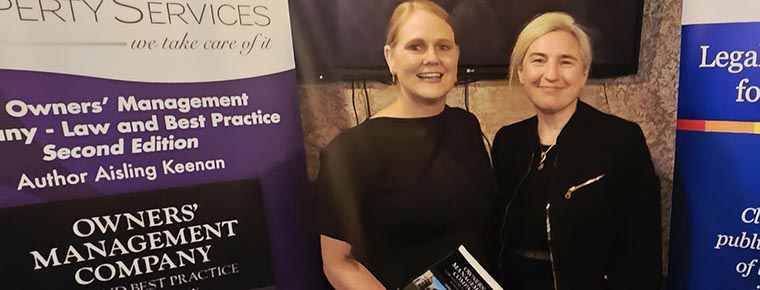
MUD reform is long-awaited, book launch hears
Aisling Keenan’s second edition of Owners’ Management Company: Law and Best Practice is published at a time when the law relating to multi-unit developments (MUDs) remains underdeveloped – despite the rapid rise in apartment living.
Published by Clarus Press, the book’s launch at The Sheds at the Bar Council of Ireland (14 October) heard that an estimated 10% of the population now live in apartments.
Much of the housing stock to be built over the next five to ten years, particularly by the Land Development Agency (LDA), is expected to be apartments and MUDs, attendees heard.
There are three additional chapters in the latest edition:
- One on the growing role of the LDA and Approved Housing Bodies,
- One addressing self-management, and
- Chapter dedicated to sustainability in a MUD.
“The Multi-Unit Developments Act 2011 is in need of significant reform in order to take account of experience in practice over the past 15 years of its operation,” said barrister Deirdre Ní Fhloinn, keynote speaker at the launch.
Significant problem
For example, Ní Fhloinn cited the failure of developers to transfer common areas as still being a “very significant problem”.
This is despite the deadline of 1 October 2011 outlined for this under the act.
Keenan’s book highlights that, in 2024, one in ten owners’ management companies (OMCs) were found to still not have a sinking fund in place, despite this being a statutory requirement under the act.
Unlike in other jurisdictions, MUDs in Ireland can only be owned by the people who own the apartments in those developments via their management companies.
The book examines why this is the case, as well as considering the benefits and burdens of being an apartment owner, such as the obligation to pay service charges.
It also deals with company-law obligations and governance of OMCs.
Financial crash
“Aisling considers the many problems that have arisen for apartment owners since the financial crash,” Ní Fhloinn said.
“These include what to do when an OMC is struck off the register of companies; what to do if a developer is insolvent and not able to meet a claim in respect of defects; and what to do if a developer is struck off the register of companies before it has completed the transfer of the common areas.”
The Multi-Unit Developments Act 2011 provides for dispute resolution, but it also provides that the Circuit Court is the exclusive jurisdiction for dealing with disputes in relation to MUDs, Ní Fhloinn noted.
“Because the Circuit Court doesn't typically hand down written judgments, we don't have a big body of law to tell us what the act means, and this is partly why it’s so important to have a resource like Aisling’s book to give that guidance.”
Keenan is a qualified property managing agent and OMC consultant at AK Property Services, with over 25 years' experience in the property sector.
Keenan is also director of the Apartment Owners’ Network and sits on the board of the Multi-Unit Developments Act Reform Group.
“We’re long awaiting reform of the Multi-Unit Developments Act 2011. It's the legislation in the area, and this reform, that’s going to really make the change in the sector,” she said.
Volunteer directors
“One of the biggest problems that we have in Ireland is the governance of OMCs by volunteer directors and how do we make that better,” she added.
“While the Property Services Regulatory Authority regulates service providers in the sector, it doesn’t not have any authority or jurisdiction over the OMC, how it operates and the governance issues within it.
“We expect the Housing Agency will have a key role when it comes to the regulation of the OMC.
“There’s certainly much to be advocated for, and there’s much work to be done, because we consider this to be young sector,” the author concluded.