'Stronger rule-of-law links to EU funds'
The European Commission aims to strengthen the link between respect for the rule of law and access to EU funding under the next Multiannual Financial Framework (MFF).
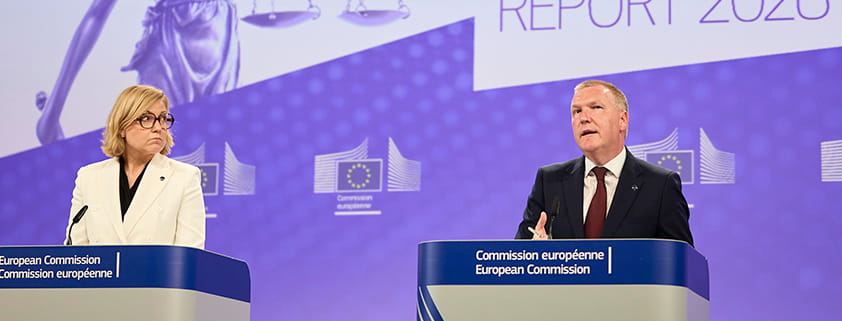
Michael McGrath (Commissioner for Democracy, Justice, the Rule of Law and Consumer Protection), described the rule of law as a founding value under article 2 of the Treaty on European Union (TEU), interpreted by the Court of Justice, and "not a wooly wish list", but binding EU law.
“And so, if you want to enjoy the benefits and the privileges of EU membership – including EU funding – then you must subscribe to and implement respect for rule of law in how you approach these issues,” he said.
The commissioner was speaking at the event hosted by the Dublin European Law Institute (DELI) at The Helix, DCU (28 October).
'Horizontal application'
The existing conditionality regulation will remain in place and apply to all EU funds. It has so far been used only in relation to Hungary.
“But what we are proposing now,” the commissioner told Professor Federico Fabbrini (founding director of DELI), “is that there would be a horizontal application of respect for rule of law and also for the Charter of Fundamental Rights, in terms of accessing EU funding”.
The commission also proposes that certain rule-of-law-related reforms be included in the national and regional partnership plans under the new MFF, drawing on the Recovery and Resilience Facility, where McGrath said the link between money and reforms had worked.
The commission will work with member states and the EU Council on the detail. He welcomed the Irish presidency's "continued ambition" on the issue.
Guidance on AI in electoral process
Speaking about the European Democracy Shield, which was launched less than a year ago, Commissioner McGrath said that it aimed to ensure free and fair elections in the EU and to respond to hybrid threats.
A new European centre for democratic resilience has been established, there is a new civil-society strategy, and the commission will shortly bring forward a recommendation on safety in politics and guidance on the use of AI in electoral processes.
He said that these measures complemented the Digital Services Act, the AI Act and the political-advertising regulation.
“We're trying to copper-fasten the foundations of democracy,” he explained, also stressing the importance of full implementation across the EU of the European Media Freedom Act and the anti-SLAPP directive.
"We're not going to save democracy from Brussels or from Dublin," McGrath said, but the EU could support member states in learning from each other and recognising the threats. He said that this applied equally to candidate countries, which faced more acute challenges to democratic integrity.
Four accession 'front-runners'
Asked by Professor Fabbrini how the commission reconciled enlargement as a strategic priority with structural rule-of-law problems in candidate countries, McGrath said that the annual Rule of Law Report currently covered four enlargement countries (Montenegro, Albania, North Macedonia, and Serbia) alongside the 27 member states.
It would not be extended further for 2027, he said, so that resources could be focused on the accession process itself and because of limited capacity in both the candidate countries and the commission.
“Front-runners” for EU accession were Montenegro, Moldova, Albania, and Ukraine, the commissioner said.
He described Ukraine and Moldova as working through the "fundamentals" cluster, covering rule of law, justice, and democratic resilience. That cluster is opened first and closed last, and determines the pace of accession.
He said that member states would insist on strong anti-corruption regimes, independent justice systems, and free media across all candidate countries.
With regard to Serbia, he said that it had not been possible in recent years to advance its accession path because of rule-of-law and other concerns, and that the commission would need to see what the Student List, which has had significant recent electoral success, stood for.
The Student List is an electoral list formed by the Students in Blockade, the student movement that led anti-corruption protests in Serbia after the Novi Sad railway station canopy collapse in November 2024.